
Have you ever wondered how the supply of physical currency is determined? I’m referring not to the broader money supply, but to actual bills and coins. As the chart below from Torsten Slok at Apollo Wealth shows, the amount of cash printed tends to track the interest-rate environment. From 2021, when rates were near zero, through 2024, when they rose above 5%, the number of new paper bills ordered by the government fell from roughly 7.6 billion to about 4.4 billion.
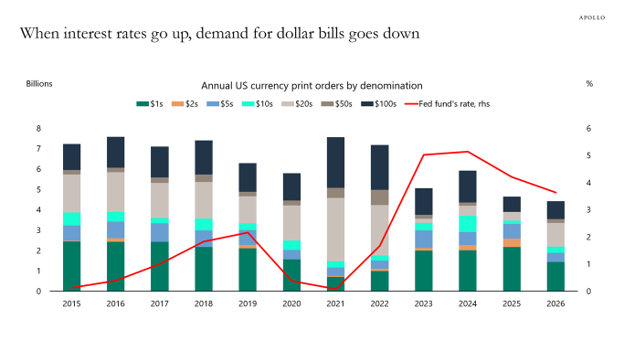
When interest rates are higher, holding physical cash means giving up more interest income, which reduces demand for dollars. Still, printed currency represents only a small share of the total money supply. Roughly $2.3 trillion in physical currency is currently in circulation, compared with about $21.1 trillion in digital money, including bank balances, electronic transfers, and savings.
While the Federal Reserve strongly influences the digital money supply through monetary policy, the printing of physical cash is largely demand-driven. The Fed orders new bills from the Bureau of Engraving and Printing to replace worn currency and meet seasonal spikes in demand, such as during the holidays.
Given current trends, demand for printed cash will likely continue to decline. I still like keeping some cash on hand, but younger generations seem to view cash as more of a hassle than using a card or Venmo. The days of the George Costanza wallet are long gone!
“This presentation is not an offer or solicitation to buy or sell securities. The information contained in this presentation has been compiled from third party sources and is believed to be reliable, but its accuracy is not guaranteed and should not be relied upon in any way, whatsoever. Fagan portfolio characteristics and holdings are subject to change at any time and are based on a representative portfolio. Holdings and portfolio characteristics of individual client portfolios may differ, sometimes significantly, from those shown. This information does not constitute, and should not be construed as, investment advice or recommendations with respect to the securities listed.
Additional information including management fees and expenses is provided on our Form ADV Part 2. The actual return and value of an account fluctuate and, at any time, the account may be worth more or less than the amount invested. Bond Investments are affected by interest rate changes and the credit-worthiness of the issues held in the portfolio. A rise in interest rates will cause a decrease in the value of fixed income positions. Past performance results are not indicative of future results.”