As we sit near all time highs in the stock market, talking diversification and broadening out your portfolio can be hard to implement. Why sell the holdings that have treated you so well?
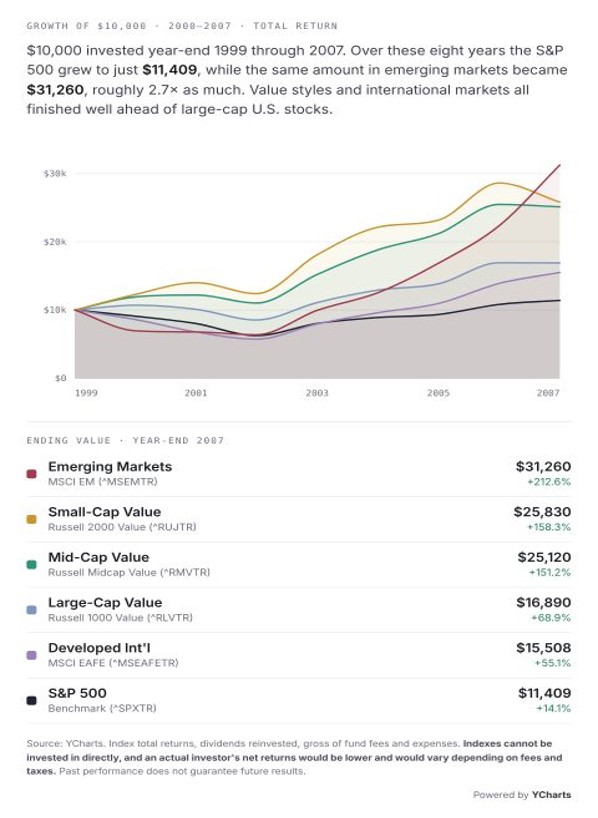
However, as you can see by the chart below, provided by YCharts, from the end of 1999 through 2007, a $10,000 investment in the S&P 500 grew to just $11,409, including reinvested dividends. Meanwhile, emerging markets reached $31,260, small-cap value climbed to $25,830, and mid-cap value rose to $25,120. Developed international stocks also finished ahead of the S&P 500. Overconcentration in a particular index or sector could be detrimental to your portfolio, especially when factoring in distributions as well as the possibility of a poor sequence of returns.
Currently, we are in a period of concentration we have never seen before. According to The Compound, the top 5 S&P 500 stocks (NVDA, AAPL, GOOGL, MSFT, AMZN) are now equal in market cap to the bottom 434 stocks as Doug mentioned on the radio show last Sunday. This has worked out well for those of us who have been invested in these companies. Going forward, diversification may not be the most profitable thing to do, but t is the right thing to do. When you are at or near retirement, you give up performance for stability, and that is what diversification does. Combining diversified equities with appropriate bonds and cash reserves can help reduce pressure to sell stocks during difficult markets and gives you flexibility when distributing assets.
“This presentation is not an offer or solicitation to buy or sell securities. The information contained in this presentation has been compiled from third party sources and is believed to be reliable, but its accuracy is not guaranteed and should not be relied upon in any way, whatsoever. Fagan portfolio characteristics and holdings are subject to change at any time and are based on a representative portfolio. Holdings and portfolio characteristics of individual client portfolios may differ, sometimes significantly, from those shown. This information does not constitute, and should not be construed as, investment advice or recommendations with respect to the securities listed.
Additional information including management fees and expenses is provided on our Form ADV Part 2. The actual return and value of an account fluctuate and, at any time, the account may be worth more or less than the amount invested. Bond Investments are affected by interest rate changes and the credit-worthiness of the issues held in the portfolio. A rise in interest rates will cause a decrease in the value of fixed income positions. Past performance results are not indicative of future results.”