When it comes to the financial markets, there is always something to worry about. Geopolitical events tend to put all investors on edge – some more than others. We have found it beneficial to look back at some of these, hoping to identify how the recent military action in Iran might affect the market. Historically, the S&P 500 has shown resilience in the face of geopolitical events, often experiencing short-term volatility followed by relatively quick recoveries. While market reactions vary based on the severity, scale, and economic impact of the event, long-term investors typically see limited disruption to broader market trends. As is illustrated within the chart below provided by LPL Research, of the 21 events listed, the average total drawdown in the S&P 500 was 5% and the recovery 47 days. Major geopolitical events - such as wars, terrorist attacks, and political crises - often trigger immediate market selloffs as investors emotionally react to the uncertainty by reducing risk. For example, the S&P 500 fell nearly 5% on the day of the September 11 attacks in 2001 but recovered its losses in about one month. Similarly, the Gulf War in 1991 and the invasion of Iraq in 2003 initially rattled markets but were followed by rallies once outcomes became more predictable.
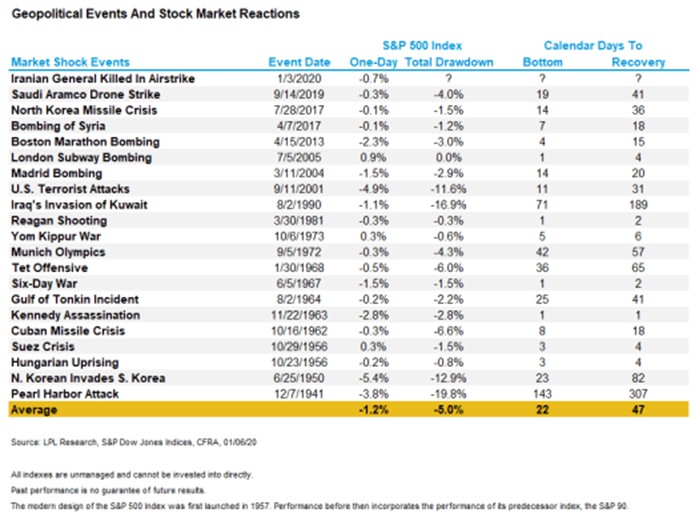
Sources: LPL Financial
While geopolitical shocks can influence investor sentiment and increase short-term volatility, they have rarely derailed the long-term trajectory of the U.S. stock market. Over the past century, despite numerous wars and global crises, the S&P 500 has continued to climb, underscoring the market’s ability to look beyond immediate turmoil and price in long-term economic fundamentals. This highlights the value of maintaining a diversified, long-term investment approach during times of global uncertainty.