The stock market has certainly seen some very volatile trading days over the last few weeks. November 5th saw a 4.3% one-day drop in the S&P 500, the largest single-day point and dollar-value loss in S&P 500 history. On a percentage basis, over the last 50 years only 39 sessions recorded worse percentage losses. When bad market days happen, it is natural to feel some panic set in. It may seem like the wise or prudent move to pull everything out of the market and put it under your mattress. However, the sharpest recovery days almost always occur days or weeks after the worst drops. As the chart below created with Google Gemini shows, the wise and prudent move is to avoid the panic sell-off.
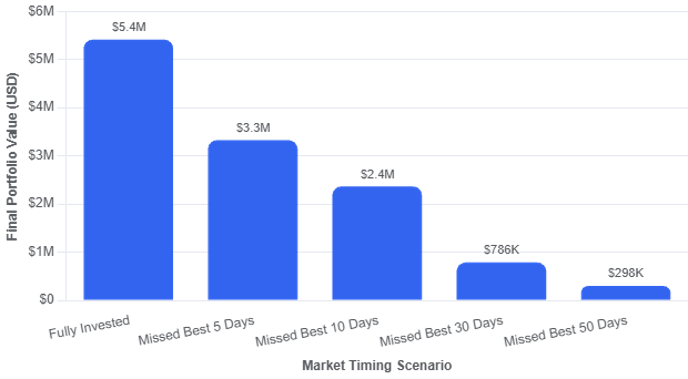
In this hypothetical scenario, if you invested $10k in the S&P 500 on January 1, 1980 and not touched a dime, you would have $5.4 million today. If you had missed only the 5 best days over that 46-year period? You’d have $2.1 million less. 5 expensive days!! Miss the best 50 and you would have less than $300,000 to show for your efforts.
It is natural to feel panic and worry on the market’s worst days. It is your money after all, and the news media does no favors when it comes to sensationalized headlines. And while historical results do not guarantee future results, history is certainly a guide we should use to inform our decisions. History is pretty clear in this regard – the wise and prudent move is to stay invested.
“This presentation is not an offer or solicitation to buy or sell securities. The information contained in this presentation has been compiled from third party sources and is believed to be reliable, but its accuracy is not guaranteed and should not be relied upon in any way, whatsoever. Fagan portfolio characteristics and holdings are subject to change at any time and are based on a representative portfolio. Holdings and portfolio characteristics of individual client portfolios may differ, sometimes significantly, from those shown. This information does not constitute, and should not be construed as, investment advice or recommendations with respect to the securities listed.
Additional information including management fees and expenses is provided on our Form ADV Part 2. The actual return and value of an account fluctuate and, at any time, the account may be worth more or less than the amount invested. Bond Investments are affected by interest rate changes and the credit-worthiness of the issues held in the portfolio. A rise in interest rates will cause a decrease in the value of fixed income positions. Past performance results are not indicative of future results.”