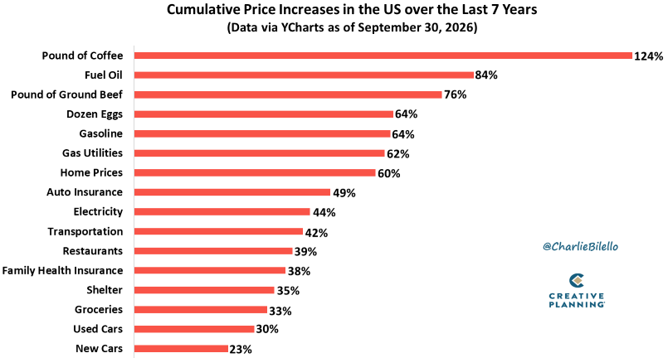
Thomas Sowell, the acclaimed American economist, has a famous quote regarding inflation. Sowell said “It is a way to take people’s wealth from them without having to openly raise taxes. Inflation is the most universal tax of all.” The Federal Reserve officially interprets its price stability mandate as a 2% long-term inflation target. As the charts below from Charlie Biello of Creative Planning illustrate, we are now at 67 consecutive months above 2%.

The cumulative effect this has on everyday products and services is eye opening.
Another famous Sowell quote on the destruction of savings caused by inflation: “Inflation is a hidden tax. The money people have saved is robbed of part of its purchasing power, which is quietly transferred to the government that issues new money.” One of the biggest issues facing retirees, and something we discuss and analyze with our client, is “how will your savings hold up over the 20-30 years of retirement.” If you are planning to spend $100,000 a year in retirement on all expenses, if inflation were to remain constant at 3.5% over the next 30 years, the table below breaks down the nominal budget required to match your current lifestyle alongside the progressive destruction of your purchasing power.

While this information can seem daunting and scary, proper planning can and will put you on the proper path to success. We are here to help!
“This presentation is not an offer or solicitation to buy or sell securities. The information contained in this presentation has been compiled from third party sources and is believed to be reliable, but its accuracy is not guaranteed and should not be relied upon in any way, whatsoever. Fagan portfolio characteristics and holdings are subject to change at any time and are based on a representative portfolio. Holdings and portfolio characteristics of individual client portfolios may differ, sometimes significantly, from those shown. This information does not constitute, and should not be construed as, investment advice or recommendations with respect to the securities listed.
Additional information including management fees and expenses is provided on our Form ADV Part 2. The actual return and value of an account fluctuate and, at any time, the account may be worth more or less than the amount invested. Bond Investments are affected by interest rate changes and the credit-worthiness of the issues held in the portfolio. A rise in interest rates will cause a decrease in the value of fixed income positions. Past performance results are not indicative of future results.”